
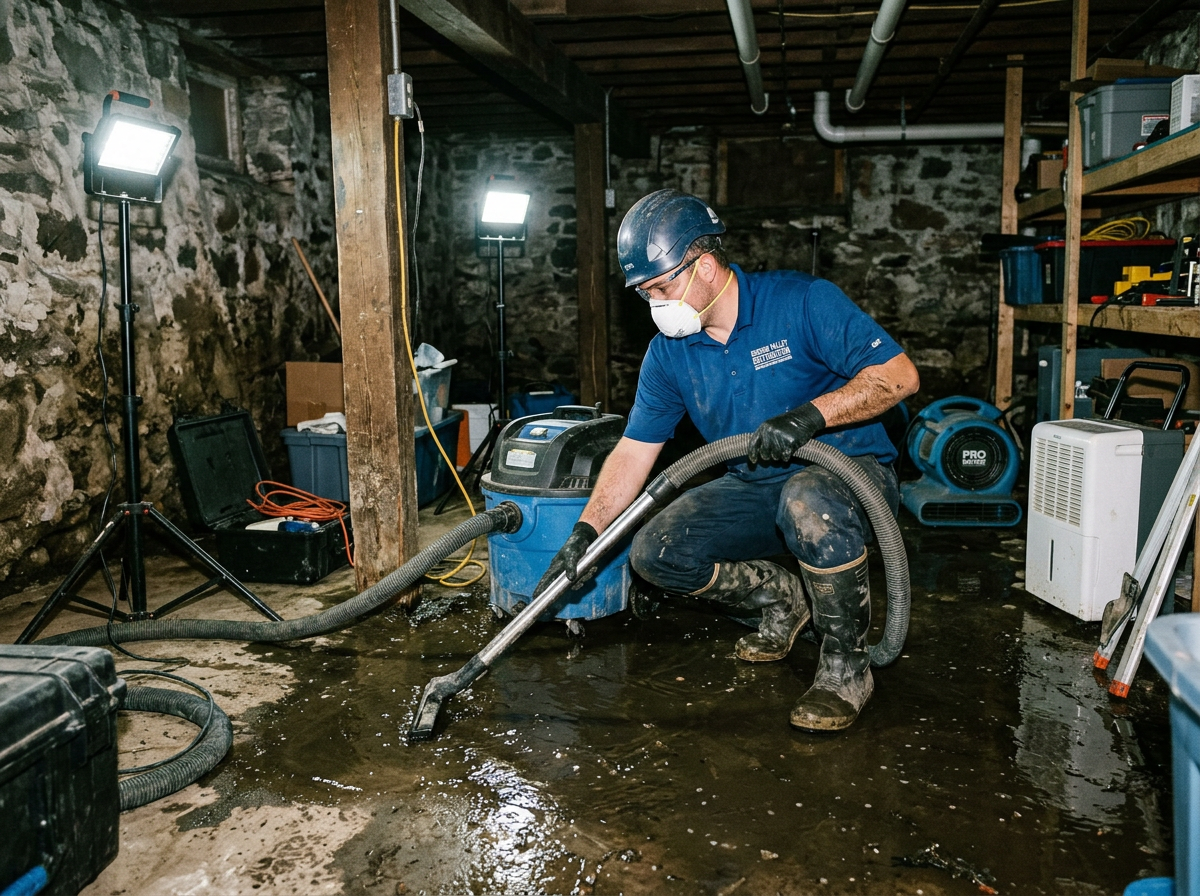
Hudson Valley basements in 19th-century river villages often sit on rubble and fieldstone foundations that were never intended to stay dry. When tidal surge or nor'easter rain pushes water against these walls, moisture travels through the stone and mortar for days after the visible flood recedes. Sump pumps that lose power during outages allow water to rise quickly, and the cold January-February temperatures can turn small leaks into ice-dam problems that keep feeding the basement long after the storm passes.
Technicians begin by classifying the water and extracting standing liquid before it reaches Category 2 within 48 hours. Air movers and dehumidifiers are placed against the stone walls rather than in open floor space so that moisture trapped inside the rubble can be pulled out. Finished basements require careful decisions about what can be saved; carpet pad, drywall below flood level, and insulation against fieldstone usually must be removed because hidden saturation will lead to mold once walls are closed.
Flooded Basement Cleanup Near You — Choose Your City
Every city below has its own local Flooded Basement Cleanup page with coverage details.
Westchester County
Rockland County
Westchester
Rockland
Dutchess
Dutchess County
Putnam
Orange
Putnam County
Jobs fail when crews stop drying too soon or skip moisture-meter checks behind the stone. In Tarrytown homes the soil stays saturated longer because of the river slope, so fans and dehumidifiers must run until readings on multiple wall sections drop below acceptable thresholds. Homeowners who attempt their own cleanup with box fans often miss pockets behind rubble, leaving hidden damp areas that surface weeks later as musty odors or efflorescence on the stone.
Crawl spaces under additions present separate challenges; water can pool against the main foundation and migrate back into the basement through the joint. Extraction here requires low-clearance equipment and careful sediment removal so that drainage paths are not blocked by silt left from river flooding.
Technician insight
In Tarrytown, the thing that catches most people out with Flooded Basement Cleanup is how long fieldstone and rubble foundations keep releasing water after the river drops. Homeowners see the floor dry and assume the job is done, but the stone stays damp for another week unless airflow is forced directly against it. Skipping that step is why we return to the same addresses after every nor'easter.
Tarrytown Fieldstone Weeping After Nor'easter
A basement on a river-slope street took on water when the sump lost power. Extraction removed the initial flood, yet meter readings stayed high along the north fieldstone wall. Equipment ran against the stone for six days until readings dropped across multiple sections. The homeowner avoided mold growth behind the remaining plaster.
Flooded Basement Cleanup Services We Offer
✓Sump Pump Failure Response
Rapid extraction and temporary pumping when power loss during a nor'easter allows water to rise against fieldstone walls.
✓Finished Basement Restoration
Selective demolition and drying of finished spaces, focusing on what can be salvaged versus materials that must be removed due to hidden saturation.
✓Fieldstone Foundation Drying
Targeted airflow and dehumidification against rubble and stone walls to draw moisture from deep within the masonry after river surge.
✓Crawl Space Water Removal
Clearing pooled water and sediment from low areas under additions that feed back into the main basement through foundation joints.
✓Moisture Mapping and Verification
Meter readings on multiple stone and wood surfaces before any wall closure to confirm drying is complete in older Hudson Valley construction.
✓Contents Pack-Out and Cleaning
Removal and drying of stored items from flooded basements before secondary damage occurs from prolonged dampness.
How it works
- 1
On-Site Assessment
Technicians inspect water depth, source, and category while noting foundation type and any finished surfaces at risk.
- 2
Water Extraction
Standing water is removed with pumps and wands suited to low-clearance stone cellars.
- 3
Drying and Monitoring
Air movers and dehumidifiers are positioned against fieldstone; moisture meters track progress daily.
- 4
Final Verification
Readings confirm acceptable levels across walls and floors before any reconstruction begins.
Pricing
Final scope depends on water category, how far moisture has traveled into fieldstone, and whether finished areas require selective demolition. Call for an inspection-based assessment.