
Suffern sits at the base of the Ramapo Mountains where foothill drainage meets older village housing stock. Crews work around mixed foundations and tight downtown access while accounting for seasonal cold that drives moisture deeper into stone and rubble.
I-87 and NY-17 provide direct routes from Tarrytown, letting the same teams cover Suffern, Viola, and nearby Ramapo addresses without rerouting for commuter patterns.
Here's how our emergency water removal work runs in Suffern — the same standards we hold across New York, delivered by the crew that covers Rockland.
Emergency Water Removal Services We Offer in Suffern
✓Emergency Water Extraction
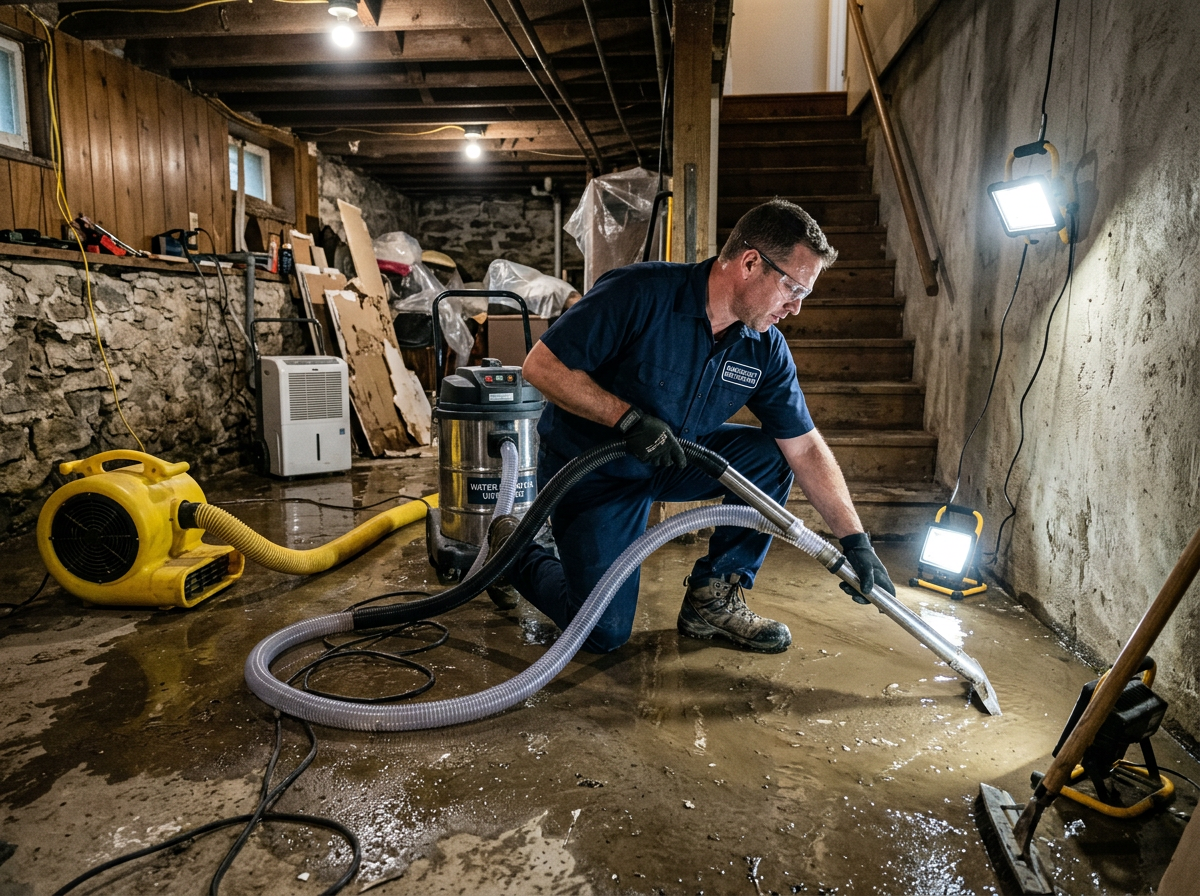
Immediate removal of standing water from cellars and crawl spaces using portable extractors sized for narrow stone stairwells common in Tarrytown homes.
✓Structural Drying and Dehumidification
Placement of air movers and dehumidifiers directed at fieldstone walls and joists, with daily moisture-meter checks until readings stabilize.
✓Moisture Mapping and Verification
Systematic meter readings at multiple depths in wood and masonry to locate hidden pockets before any wall or floor is closed.
✓Carpet and Padding Removal
Cutting and disposal of saturated carpet and pad that would otherwise trap moisture against slab or subfloor in older river-village homes.
✓Contents Pack-Out
Inventory, removal, and off-site drying of furniture and stored items from flooded basements when on-site drying space is limited.
✓Sewage and Category 3 Cleanup
Extraction and disposal of contaminated water from backed-up sumps or flood events, followed by disinfection of affected stone surfaces.
In Tarrytown’s 19th-century river-slope houses, water from a burst pipe or ice-dam leak hits fieldstone and rubble foundations that were never meant to stay dry. Within the first hour the water begins wicking upward through mortar joints and into floor joists. Our crews arrive with portable extractors sized for tight cellar access and pull standing water before it migrates behind plaster or into finished spaces above. Every extra hour multiplies the affected square footage because these thick stone walls release moisture slowly and unevenly.
Once visible water is gone we place air movers low along the walls and dehumidifiers in the center of the space, angling airflow to follow the natural slope of the cellar floor toward the river. Moisture meters are inserted into joists and base plates at multiple depths; readings above 18 percent dictate continued drying rather than closure. Jobs fail here when homeowners close walls too soon or when crews skip mapping hidden pockets behind rubble. We leave the structure open until meters confirm equilibrium with outdoor humidity.
How It Works in Suffern
- 1
Arrival and Containment
Technicians assess water source and category, then isolate the affected area to prevent migration into unaffected rooms.
- 2
Standing Water Removal
Portable extractors pull water from floors and low points, with attention to the slope of stone cellars toward the Hudson.
- 3
Drying Equipment Setup
Air movers and dehumidifiers are positioned to follow wall lines and joist runs; equipment is checked daily.
- 4
Meter Verification
Moisture readings are taken until wood and masonry reach equilibrium; only then is the space released for reconstruction.
Serving All of Suffern
We regularly handle emergency water removal jobs near:
- 📍Suffern Railroad Station
- 📍Lafayette Theatre
- 📍Historic downtown Suffern
- 📍Viola neighborhood
Emergency Water Removal Pricing in Suffern
Scope depends on water category, volume, depth of penetration into stone walls, and number of days drying equipment must run; call for inspection-based quote.
Want the full picture of this service? See our Emergency Water Removal page, or everything we do in Suffern, NY.